Tuesday, December 25, 2007

Merry Christmas from Zanzibar!


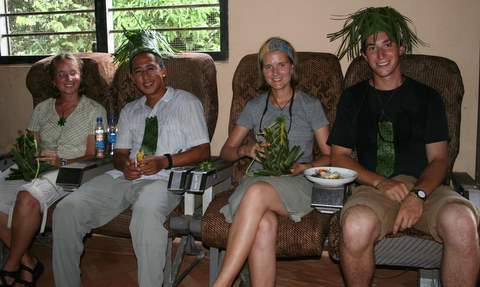
Merry Christmas and Happy Holidays everybody! We hope that your holidays are as exciting and filled with palm-leaf hats, airplane seat furniture, and happiness, as ours. We miss you all!

Courtney and Arthur and Bebeth and Mark

Wednesday, December 12, 2007

Bugs 2

We posted the other day about bugs. It turns out we jumped the gun. The rains have come and it rained hard for two days. By the second night it had let up and it was nice and cool out. We were under our net reading enjoying an rare night of electricity when we started to hear an unusual number of bugs in the room. Courtney got up to investigate. She walked into the other room where we had left the front door open, which turned out to be a big mistake. She came running back into the bedroom because the “dinning” room was filled with flying bugs! They were pouring in the door, hitting the windows madly, and coming in through any hole they could find. We proceeded to run around the house to shut all doors, turn off all lights, and kill all the bugs by hitting them with a shoe. We now have red shoe prints and dead bugs all over our walls, but it did the trick.

After the rains these bugs, which look like ants with 1 inch wings, come crawling out of the ground. We think they are some kind of termite. They all hatch at once and fill the air. The air is so thick with them with them that there is one almost every three feet. If you can get over the fact that they are bugs it is kind of pretty as long, as they aren’t in your house.

The next morning when we got up the ground was covered in their wings. We are not sure if they got eaten and the wings are left behind, they had finished their life span already and died, or they shed their wings. For some reason the wings are all in piles around the base of trees and buildings (as you can see in the picture). When we went for a walk that morning we found 10 of the local kids around the community center building with pots. They were eagerly collecting the bugs to eat! As you can see from the picture they do not look that appetizing but we hear that they are high in vitamin A and protein. We have yet to try them. The bugs here keep us on our toes and are every changing.


Wings at the bottom of a tree
Girl Showing off her bugs
A pot full of bugs that the kids were collecting to eat

Saturday, December 8, 2007

Long Days

This is a post that we wrote almost 2 months ago, but never posted. Some things have changed. Some have not.

In our past posts we described how we have extra time on our hands. But for some reason we are always tired. We aren’t running a marathon, we aren’t taking a huge exam, but we always feel like we have done both. That’s because daily activities here are very draining. Our 45 minute trek to town does us in. We walk through one of the poorest neighborhoods in the area. The kids have one outfit that is beyond dirty and ripped and most of the time half hanging off of them. They are eating unripe mangoes that are the size of a golf ball because they have nothing else to eat. All at the same time running after us yelling “Mzungu” and wanting to walk with us. We do our best to say hi to everyone and their brother along the way but invariably we manage to miss someone who will then proceed to get mad at us in Swahili so we don’t even know what they are saying to defend ourselves. We then make our way through town picking up food for the next few days. We pay twice as much as we should since we can’t understand the prices and ask things like “do you buy bread” instead of “do you sell bread” and get strange looks because we messed up our vocabulary. Then we have to walk back through the same neighborhood with a bag full of food that costs more than people make in a month.

When we get home we stumble through greetings with one of the Mamas who are working on building the community center (they are putting concrete on the buildings and painting them to protect them from the rain). These women will work for 12 hours that day carrying buckets of water on their heads for 500 yards from the tap to the building. For all this hard work each woman will receive 2000 TSH ($1.70) per day. This is more than most places pay, which is about 1500 TSH ($1.20). And through all of this the women feel lucky because most people around here don’t have a job. That wage wouldn’t even buy you one jar of local peanut butter here, for which we pay 4000 TSH, or a lunch of chicken soup which costs 2500 TSH.

By this time the preschoolers have gotten out of school and run by our house. They head straight for the trash pit behind our house. All of our waste, which isn’t much compared to the amount of trash we produce at home, gets thrown into it. The preschoolers jump into the pit and rummage around to see what treasures they can find. Maybe a ripped plastic bag, or an empty water bottle. Both of which are a big find. Mind you, they are children whose parents are well off enough to pay 1000 TSH a month to send them to preschool. When these children or one of the other 15 that come to play soccer throughout the day ask for candy, water, or an empty water bottle, what do you say? We can’t feed the entire town. If we give our empty water bottles out, which of the 20 kids do we give it to? How do you explain in a language that you can’t speak that you have more stuff than they can imagine but you can’t give them a little left over food? On top of this, the community thinks we are paying to plaster and paint the buildings, since we arrived two days before work started. No matter how many times or ways they are told that we are volunteers and we didn’t pay for the buildings it doesn’t matter.

By 4:00 we are ready to crawl into bed and lock the door. But this is why we came. We want the kids to run after us to talk. We want to the kids to come and play soccer. We want to try to grapple with the fact that at home we eat more food in a week than most eat in a month here. We want to learn about a new culture and way of life. So while it may be overwhelming and draining, it is also exciting and a learning experience. It is all worth it when you manage to say you are trying to learn Swahili to the man in the market who is selling carrots and he thinks you are the great for trying and smiles and tells you “karibu sana Tanzania, rafiki yangu.” “You’re very welcome to Tanzania, my friend.”

Bugs

One common theme in all our letters, blog posts, e-mails, and phone calls, is bugs. Bugs here are bigger, there are more of them, they are crazy looking, and they are everywhere. Every night, the mosquitoes come out as thick as a cloud and the spiders prowl the dark. The cockroaches, larger than those at home, can fly, and patrol the air at night. In the field, the grasshoppers fly in every which direction with every step you take. They can be as long as your hand and come in every color possible; red, green, pink, purple. We thought we would share a few of these bugs with you!


Wednesday, December 5, 2007

New phone number

In the past few weeks we have losted our phone. But have no fear we have a new one with a new number so you can still call us!
+255-7820-42471

As always we love hearing from everyone via snail mail, e-mail, and phone!

Container

We haven’t posted much about the state of Africa, NGOs, or the like. So here goes…

The NGO that we are volunteering for sent a container from the USA to the community center. People at the community center, us included, had been very excited about it because it was suppose to contain good educational materials and things for the center. We were particularly looking forward to receiving books to start a library. After traveling for over a year, the container arrived in Songea this Thursday morning. While it did contain some of the items we had been hoping for, it also contained many other things that were surprising, kind of crazy, and down right useless.

First the books. As promised, there were thousands of books in the container. We were excited. But after opening all the boxes, we discovered that we were sent 20 (sometimes 40 or more) copies of each book. It is hard to fathom what we will do with that many copies. It is harder to fathom what we will do with one, much less 20, copies of some of the books in particular. A few prime examples are How to Grow Shrubs and Trees in Cold Climates or Do I want to be a Mom?. (This book explores many of the American issues associated with motherhood. We were lucky enough to get 40 copies). How about 20 copies of electrical wiring for semi conductors, or many of the books that are in French or Spanish.

Educational Materials: As we have posted before, the schools here have very little, if any, resources. The preschool was very excited that there were educational materials coming. Once again, it was very interesting to see what was sent. For those who are teachers you might have heard of Open Court, a phonics-based reading program. This is a very complicated program that has many materials (books, flash cards, work books, etc). We received 15 copies of the Volume 1 kit, 15 copies of the review kit, and one copy of volume 2. Many teachers in the US (who speak English) go to training courses to understand how to teach using this method. Many teachers in the US would be very excited to receive these kits but it is hard for me to imagine how one, much less 15, of the same kit will be put to use here. Neither the teachers nor the students speak English. The school still does not have basic educational supplies such as paper, pencils, markers, or anything of the sort.

Toys: There were a couple of boxes of toys that arrived (we are guessing for the preschool) that are very interesting. Most are brightly colored, battery operated (people cannot afford batteries here), hunks of plastic crap. The kind of toys you see in the store and wonder who actually buys them. Others are Barbie-type dolls that are scantily dressed, which in this culture is associated with prostitution. Lastly, there are four tents. People don’t camp around here, but you never know, we could start a camping club!

Oh, and best of all, every single book is affixed with a giant sticker that says “for donation only – not for resale.” The stickers literally take up a third of the book cover. Which is great, so when kids are looking at the book on how to grow shrubs in cold climates, they can remember that the totally irrelevant book was given with generosity and thoughtfulness.

Monday, November 19, 2007

Mango is here!

I’m not a cat person. But while on vacation in Mbamba bay, we decided that we wanted a pet, and the question became which type of animal. Courtney wanted a cat, but I’d always been a dog person. I halfheartedly agreed to think about getting a cat, fully intending to never agree to actually buy one (how catty of me?).

Soon after returning from vacation, we were walking around town and saw a little kitten playing. Undeniably cute. So we asked the nearest kid where we could get one of our own, and he went running off to find his father. I thought we were merely window shopping. But when the father came out of the house, he was carrying one of the cutest kittens in Africa. Once I saw her, there wasn’t even a question as to whether we really wanted a cat or not. We bought Mango on the spot.

The only reason we hesitated to buy a pet is that we would have to leave it here (sorry, she can’t come back to the USA). We worried that whatever we got would probably grow soft living with us, and have a very hard life once we left.

So with Mango, we pledged to help her stay a bit wild. Not a problem. The first night, Mango hunted and ate a huge cockroach in the house. Nice! The next night, she killed and ate a disconcertingly large and disconcertingly poisonous spider. Thanks Mango! What a great cat!

Alright, so I’ll admit that cats are cute. And having one that eats our spiders is nice too. But will I actually get attached to her? I already have. The other day, we went for a walk with Mango and she ran off. We assumed she would come back, but she never did. We looked for hours but found no trace, and went to bed catless. Poor Mango! The next morning, when local kids returned her to our house, I was so happy to see Mango again!

So have I become a cat person? I’m getting there, but not quite. I’ll admit their cute, and it’s great to have a pet here. But when Courtney and I get a pet in Michigan, we think it’s going to be a dog.

*But in the meantime, we’ll be updating the blog with the adventures of Mango the cat, so enjoy. She leads quite an exciting life!*

The cat on her first day after a bath!
Arthur working with the cat sleeping in her favorite spot
Arthur and Mango cooking

Friday, November 16, 2007

Buses

To give you an idea of what a bus ride in Tanzania is like we want to describe our bus ride to Mbamba Bay last week. The trip started at 6:00 in the morning at the bus station. The bus station is crowded because all the buses try to leave at the exact same time. Because there are so many people around, especially travelers, the vendors are out in force catering to them with anything from bottles of water to meat on a stick to toothbrushes and toothpaste. We were tempted by the chocolate crackers, but abstained.

Our bus from Dar to Songea was rather nice (the route, through the mountains, is so arduous that apparently the buses only last a year), but our bus to Mbamba Bay was just plain old and dilapidated. The walls were covered in peeling red velvet, the seats had lost all their cushion so we basically sat on two metal bars, and the bus shook uncontrollably. Our window, sadly, did not open.

This became a big deal when we realized just how many people were getting on the bus. When we left the station, there was a passenger in every seat and about 5 people standing in the aisles. But every few minutes, we would stop and let five more people on, somehow cramming them into the nooks. Within 30 minutes, we had stopped 5 more times and there were passengers standing on every inch of floor, and more crammed into the spaces in between the ones standing and sitting. We had paid about $6 each for this particular 6 hour drive, and we wondered how the company could make money. The answer is that a Tanzanian bus fits twice as many passengers as an American bus, though both have the same number of seats.

And some of the passengers made us want a bit more personal space. The woman behind us held a sickly chicken on her lap the whole way, a man got on holding a sack that was meowing (even the locals looked at him funny), and the woman across the aisle had a very unhappy baby that was vomiting prodigiously. At this point, we forced our window open.

But to only use buses to transport people would be to waste a valuable resource. Local mail is notoriously unreliable, so people have turned to the bus system as an alternative. At the stops, people would give letters to the touts (3-4 guys who stand at the front of the bus and help passengers with issues, deal with checkpoints, and fix flat tires), who would stuff them in their pockets. When we reached Mbamba Bay, the touts pulled the crumpled, sweaty envelopes out of their pockets and give them to the intended recipients. This is apparently preferable to the local mail system.

The buses are also used to transport merchandise between towns. The top of the bus is pilled high with baskets, plastic flip flops from china, mattresses, and anything else imaginable. At one point, a man carried on a 10 gallon bucket of fresh milk. We even passed a bus that had a live goat tied to the roof!

Sound like fun? Absolutely! Sitting in our seats, someone’s knee sticking into us, an arm pit by our heads, and a chicken squawking next to us, we looked at one another and started to laugh uncontrollably. Then the bus stopped, and five more people got on.

Saturday, November 10, 2007

On the palm-fringed shores of Lake Nyasa...

The adventure started sophomore spring at Dartmouth. Four and a half years later, Courtney and Arthur were in Mbamba Bay Tanzania, on the shores of Lake Nyasa. After living in Songea for a month we decided to take a vacation. Tuesday morning, we got on a rickety old bus and bumped our way down a dusty dirt road for 6 hours to the third largest lake in Africa. The ride was an adventure in itself, but we’ll save that for another blog post. Suffice it to say, we made it in one piece to the small dusty town of Mbamba bay on shore of Lake Nyasa. The town is a 100 foot long line of small shacks that sell mostly produce grown in the area, and not much else. But what the town does have an ample supply of is crystal clear water, long beautiful beaches, palm trees, beautiful views, and mangoes. And, even though it clearly wasn’t a tourist town, we lucked out and found a hotel with a real toilet and a shower. Wednesday morning, we set out for a walk along the beach to explore the area. Arthur was acting a bit funny. We walked through the hills passing through people’s front yards, being followed by kids, and chatting with the locals, until we found a peaceful secluded piece of beach. Sitting in the shade under the palm trees with stunning views, Arthur proposed to Courtney. With a ring made in Songea Tanzania on her finger, Courtney said yes! Nothing could have made it a more perfect moment. After eating fresh mangoes right off of the tree and a dip in the lake it couldn’t have been a better morning! The day was topped off with drinks on the beach and a beautiful sunset, followed by a dinner of just-caught catfish at the one local restaurant. While the rest of the trip was great, nothing could top the first day. We are now back in Songea rested, happy, and very excited. We wish we could be with all of you at home to celebrate but we are thinking of you all, and having a grand ol’ time over here in Tanzania.

Courtney and Arthur celebrate on the beach after a quick dip.
The dusty strip of Mbamba Bay
A beautiful sunset over the lake

Courtney and Arthur at our romantic dinner

View of Lake Nyasa from hotel room.
View of Mbamba Bay from the hotel porch.

Monday, November 5, 2007

Hike

This weekend we went on a hike to the top of one of the surrounding mountains. It was a beautiful hike. We crossed two valleys, walked through a forest where the trees were turning (why we aren't sure), saw great views, and didn't encounter any snakes. Here are some pictures from our hike and views of our village.

One of the many crazy bugs that we came across on the path

A flower that must have been a Doctor Seuss inspiration

We climbed to the top of the mountain on the right. You can also some what see the pretty colors the trees have turned

Us at the top with our village in the background

Pictures again

Arthur very excited to have our first avocado of the season!
Courtney learning to cook chaptis with Pascaria in our "kitchen"

Friday, November 2, 2007

More pictures

Here are more pictures from the past month in Tanzania. More to come soon.
Arthur with Felix (director of the community center) at the communty center Beautiful clouds above the community center building
Kids at the dental center (also at the community center) waiting for their monthly cleaning
Augusta cleaning one of the kid's teeth


Food

We posted two weeks ago about food. You know where we get food but we haven’t told you what we eat. Well that is pretty simple. Rice and Beans! Ok we eat more than that but it seems like that is the only thing we eat. For breakfast we have tea or coffee with fresh local milk. For most people around here that is all they eat for breakfast so we had to be creative. Bananas are abundant around here and we have found local peanut butter and a good bakery so our breakfast has expanded in the past few weeks. For lunch we have rice, beans, and some kind of greens. The greens alternate between fried/sautéed cabbage with tomatoes or fried/sautéed lettuce with onions. The only flavors to add are onions or salt. For dinner it is what ever we have left over from lunch. This is all made with a few items. A charcoal stove that is about 1 foot high that looks like two bowls put end to end. Then we have a few pots and one frying pan and a wooden spoon. That is it. We are gone from the land of fridges, microwaves, ovens, toasters, or anything else modern. Cooking like this can be very challenging. What happened to Easy Mac, spaghetti, and toast? Here the first challenge was trying to light the stove. This takes 20 minutes. If you manage to get it lit you now try cooking with limited ingredients with one temperature stove. I thought we could handle pop corn. We had cooking oil and kernels so I thought this would be no problem. The first attempt we couldn’t even get the stove lit. The second try only about ¼ of the kernels popped and these were only half popped. Who knew how great jiffy pop was? We have given up and are now buying pop corn from a local women in town for a bag of for 8 cents. Mama Sofia is now teaching Courtney how to cook. This involves Mama Sofia laughing at Courtney and taking over so lunch isn’t ruined. So far Courtney has learned to make Ugali, rice, and veggies (even though Mama Sofia thinks Courtney chops the veggies too big). Each day is an adventure!

Thursday, November 1, 2007

Arthur with Nyoka on deadly hoe (and wearing striped socks with sandals).


Soccer kids with the snake (ok, not that big, but poisonous nonetheless)

Nyoka!

We’re lucky enough that our house came equipped with a few old, semi-inflated basketballs, so we have a host of local kids who come to play soccer every afternoon. They tend to be pretty dedicated to their soccer, so when we they stopped playing yesterday afternoon, we wondered what was up. Five minutes later Moses, the next door neighbor’s son and an afternoon-soccer regular, ran to the house yelling Nyoka! Snake!

There are quite a few different types of snakes in our corner of Africa, and they’re just about all poisonous. So what did we do? We followed Moses to the spectacle that had distracted all of the kids from soccer. In the middle of one of our fields, at the bottom of a 5 foot deep concrete-lined irrigation hole, was: a pile of rocks. With a foot of snake tail coming out the end.

Kids around here know the appropriate action to take when they see a poisonous snake: either run away or, if you can, kill it. Well this snake had gotten itself trapped in the irrigation hole, so was an easy target for the latter option. So for the past five minutes, the kids had been hurling bricks and chunks of concrete at the snake, and by now it was almost entirely buried in rocks and what we could see – the tail – had stopped moving. Was it dead?

We thought so, but when the kids started taking the bricks off the snake (using a 7-foot long stick, of course), it started to wiggle. When they uncovered its head, it was clearly still a very much alive – and very angry – Black Mamba snake. It flared its neck out and started hissing. So… we started throwing more bricks at it. Some hit the snake’s body, mildly impairing it. But eventually, one hit it squarely in the head, and it lost its vigor.

But it was still struggling. By this time, Courtney had run to the house to retrieve her camera and our gardening hoe (good thinking!). The snake was near the edge of the pit wall, and within the reach of the hoe for someone six feet tall. So I chopped the snake’s head off. Dead.

So what do 10 pre-adolescent boys ask one another in the presence of a dead poisonous snake? The answer is the same on this side of the world: Unataka kula? Want to eat it?
Hapana, sitaki kula nyoka, asante (no, I don’t want to eat the snake, thank you). Instead, we buried it behind the house, and went back to playing soccer.

Monday, October 29, 2007

Every Teacher’s Worst Nightmare (by Courtney)

I am not sure what every teacher’s worst nightmare is but I am sure everyone has one. It is the nightmare that keeps you up the night before the first day of school. The other day I lived through my worst nightmare. The first day I went to the preschool the teacher was late. I sat down on the front step and ten preschools came running at me. They sat down as close as they could to me holding on to me any way they could. I had 20 eyes looking at me expectantly. I tried asking them what the liked to play. But all I got was blank looks. I tried asking them if they knew any songs. Blank looks again. There was no teacher in sight and I had ten 3-6 year olds waiting for me to do something. Every teacher has a tool bag of tricks and I couldn’t use any of them since I didn’t know the language. So I did the next thing I could think of which was to sing “Twinkle Twinkle Little Star.” As soon as I started singing all the kids chimed in. I was saved for at least a few moments. The teacher arrived and all the kids filed into the room. I sat in the back and watched. There were 15 students sitting in rows. The teacher started reviewing numbers in English. After 20 minutes the teacher disappeared for 10 minutes. What do you think happens when you leave a room full of 3 year olds alone for 10 minutes? They start running around, yelling, hitting each other, and crying . Before things got too out of hand the teacher returned. Since it was my first day I didn’t know if this was how things normally went. After another 20 minutes the teacher disappeared again. The kids had been sitting for an hour now repeating numbers in English. Three year olds have an attention span of about 10 minutes. I figured out that the teacher was leaving to go teach the other class since the other teacher wasn’t there that day. I didn’t know how to ask the teacher if she wanted my help since she didn’t speak English. So once again the kids started running around, yelling, crying, and hitting each other. The teacher in me kicked in and I tried to get them to sit down and stop hitting each other. But how much can you do when the students don’t know you, they have been sitting for way to long, and you don’t speak the language? Not much. All I knew was that I had woken up and was in my worst nightmare. Since that day things have gotten better at the preschool but it is a challenge. The teachers have no official training and the kids sit for the entire class repeating words out loud in English. Not my idea of an ideal education but it is very hard for me to help the teachers or teach the kids with out having a common language. Each day we try again and each day I get a little closer to feeling like I am a capable teacher.

Thursday, October 25, 2007

Pictures

Here are some more pictures of of our life in Songea!

Felix (our house mate and the head of the community center) and Courtney showing off Courtney's new found hobby of crocheting.

Arthur helping our the neighbor get a truck unstuck from our neighbor's yard after picking up bricks that he makes.

Courtney with our afternoon soccer buddies on our front porch

Our Neighbors

We thought we would introduce you to our neighbors. There is King George, King Henry, and King Mzungu. They kindly wake us up every morning between 6:00 and 6:30. King George has much nicer crow but we do not know how to explain to King Henry that we would prefer if King George give us our wake up call. Most afternoons they bring their families to our front yard for afternoon foraging. If you have watched barn yard behaviors of chicken families you would know what makes a good rooster. Both King George and King Henry are good guardians of the roost. They lead their brood to good foraging grounds to hunt for worms, ants, or anything else that they might find. They might even be so kind as to bring a worm right to one of their ladies if they find a good one. King George has a habit of wandering away from his family but as soon as he hears a call of distress his head lowers, body tilts forward, and with feet flying out behind him he makes a bee line to his family. It is a very funny sight to see a chicken run. These birds are truly free range chickens and can breed (naturally with no help of humans!) with any chicken they so choose. The outcome is some very beautiful color combinations (and tasty flavor when they become kuku supu). Luckily for these birds we have made the fatal mistake of naming them which will make it very hard for us to bring them to our table. Welcome to the neighborhood!


King Henry

Sunday, October 21, 2007

Time

Time is very different here. There are many different types of time and there is lots of it.  There is more than we know what to do with.  That might seem weird to those of you at home who wish there were 30 hours in the day but here we some times wish there were 15 hours in the day.  Everything moves a lot slower here. Having one meeting a day that lasts an hour is having a lot to do.  But what do you do with the other 23 hours in the day?  That is limited when you are in a very rural setting and you don't speak the language. We read, write, crochet, sleep a lot, but that can only take up so much time.  People here have a very different concept of time. There is local time. If you have a meeting at 10:00 that really might mean 11:00 or even tomorrow.  So to accomplish something that would take a day at home might take a week or even longer here. Then there is Swahili time. Their time starts at sunrise and ends at sundown.  So 7:00 am is 1:00. 12:00 pm is 6:00.  It can be very confusing when asked what time is it.  Then there is US time. Those of you on the east coast are 7 hour behind. This can make it challenging to set up a time to talk. Then there is Courtney time. My watch is broken and I cannot reset the time so my watch is always one hour behind.  There is so much time that we spend half of it trying to figure out what time it is. 

Monday, October 15, 2007

PIctures

Here are some pictures from the last two weeks. We will post more next week. Enjoy!


Our afternoon soccer buddies and a wonderful African sunset


Courtney with pre-school kids


Arthur playing soccer

Courtney sitting in our room
Courtney on the porch of the house


Local Food for Blog Action Day

What does it mean to be an environmentalist these days? Being socially conscious? Being a hippy? Winning the Nobel Peace Prize? Eating all local and organic? Not all environmentalists receive prizes in Stokholm, but even Al Gore must sometimes choose between local and organic food. Which is better: the local apple grown with pesticides or the organic apple that travels thousands of miles from New Zealand? Today is blog action day, a day where all bloggers post about the environment. We think that being an environmentalist means being more connected to the land. So today, we will describe our adventure with getting food and eating it in Songea.

Coming from New York City and Boston, we are used to being able to get anything we want at any time of year from any where in the world. But we generally had no idea where our food came from, who grew it, or what it took to ship it to us. Now we are living in Songea, Tanzania. Our food choices are limited, but we know that everything is local. The person selling it is the same person who grew it, and we most likely walked by her field on the way to the market. When we hand over our money we know where it is going. Food is cheaper, but the farmers get all of the profit, and nothing goes to big corporations, shipping companies, or super markets. Do we miss all those choices of the super market? We would be lying if we said no. But the lack of food variety, and the fact that it’s all local, has taught us to appreciate the labor involved, and to appreciate the growing seasons a lot more. We also know that it’s fresh, and we know that is tastes great. In a month, avocados and mangos will be in season here and we can’t wait for them. Because we can watch it grow and know when it will be ripe enough to pick, that first avocado will taste better than any avocado we have ever eaten. So maybe there is something to be said for not having everything you want at all times. Maybe the strawberry that flew halfway around the world and was picked before it was ripe is worth leaving on the shelf, because we’re willing to wait for the juicy flavorful ones in the middle of the summer.

Moving to Tanzania has made eating local a lot easier for us, though only because it forced us to do so. But when we get back, we plan to put more effort into shopping the local farmers’ markets and figuring out what is actually in season, and what had to be shipped on an airplane to reach us. So while we’re waiting for the avocados and mangos to ripen, see if you can eat local, too, and let us know how it goes. We hope that you find some surprisingly yummy new foods. And when you do find some, think of us in Songea, eating our rice and beans for the next month.

Tuesday, October 9, 2007

Songea

We have made it to Songea Tanzania.  We have been in the country a week and it is already an adventure.  We spent two days in Dar es Salaam buying bus tickets, trying to arrange visas, and arranging for our trip to Songea.  A good friend of MCW is Ambassador Mwakawago. He was the Tanzanian ambassador to the UN for many years and then ran all UN programs in Sierre Leone for two years. He is now retired and living in Dar. We went to his house for dinner to help him break fast (it is Ramadan).  We had wonderful transitional food and tried our hardest not to do something culturally inappropriate.  The next morning at 5:15 we were off to the largest bus station in East Africa.  We manage to get on the ride bus and we were off to Songea. The bus was new, the road was good, and we saw elephants and giraffes out the window on the ride there!  The bad part is it took 15 hours!  Felix (he runs the community center) met us at the bus station and helped us get to the community center which is out side of town.  Songea is the largest town in southern Tanzania. The town has a market that is open everyday and an open air market on Sundays. But there is no grocery store or any store you would find back home.  You either buy it in the market or in one of the many small "stores" which consists of three walls and a counter in front in a space of 10 ft x 6ft.  We live at the community center which is in the town of Kipera about a 45 minute walk outside of town.  We live in a house with Felix which consists of two bed rooms, a common room, a kitchen, and two choos (bathroom - aka hole in the ground).  The kitchen consists of shelves and a table. The bed rooms have a bed, a small book shelf , and a mosquito net. The common room has a table, three chiars, and a desk.  That is our new home! On the community center is two classrooms for the pre-school, a dental center (which has all the equipment but isn't open right now), a couple homes where community members live, a community center, a library (no books though), and a computer room (only two work I think), and lots of kids who want to play soccer.  That is it for now! We will post pictures and more about life here in Kipera later.


Friday, September 28, 2007

We are off to Tanzania

My three weeks in Cape Town have come to an end. The city is wonderful and I highly recommend it to anyone who is coming to this part of the world. In my three weeks I have seen penguins, whales, seals, and tons of birds. I have gone hiking on the Cape of Good Hope, wine tasting at the many vineyards, toured Robben Island, spent two beautiful days at Kirstenbosch Botanical Gardens, gone to an environmental film festival, experienced South Africa's first environmental rock concert, eaten lots of good food, learned how to play the game of settlers, learned how to crochet, and had lots of fun with Bebeth and Mark and their friends (and business partners) Sam and Miranda. I have posted a few pictures highlighting the last three weeks. You can view them at http://picasaweb.google.com/Courtneyschenk/SouthAfrica

As I post this Arthur is in the air on his way to Africa. I will meet him in Dar es Salaam Tuesday afternoon to start our adventure. The next post will be from both Arthur and I in Tanzania!

Monday, September 17, 2007

Hello from Cape Town

I have been living in Cape Town, South Africa for the last week. Bebeth and Mark have been kind enough to let me live with them in their apartment for three weeks. Cape Town is a different side of Africa. One more similar to home. It is like any city around the world but even better. It is amazingly beautiful! It is surrounded by Table Mountain National Park on one side and the ocean on the other. We are living in Green Point which is on the side of Signal Hill (part of Table Mountain National Park). From the apartment you can see the ocean and the mountains. We are a 15 minute walk from downtown, 5 minute walk from Sea Point (any kind of shop you could want) and a beautiful walk along the ocean. Bebeth and Mark are in heaven since Cape Town has great restaurants, many big groceries, and anything you want only a few minutes walk away. This is a welcome change from Kenya for them. My favorite part of Cape Town is the easy access to beautiful outdoors. We are a 5 minute walk from Table Mountain National Park and a beautiful walkway along the ocean (my favorite place to run every morning), and hour drive from Cape of Good Hope, and 40 minutes from Penguins! To give you an idea why I love this place Bebeth and I go for a run every morning along the ocean. One morning we had to one side the amazing backdrop of Signal Hill and Lions Head, to the other side we had huge waves crashing along the walkway spraying up, and off on the ocean is rain crating a rainbow. Can it get any better you ask? Yes! About 100 feet away are 20 Right Whales playing in the waves! Yes Bebeth and I were typical tourists (or lovers of nature) jumping up and down pointing and watching them slap their flippers and flash their flukes Running doesn’t get much better than that!

This weekend we rented a car and explored the area. To get any where around Cape Town you either drive along curvy roads along the ocean (reminds me of the coast of Maine) or you drive over beautiful mountains passes. Saturday we went and saw the Penguins at Bolder Beach. The African Penguins (used to be known as Jackass Penguins) nest on a beach along the coast where you can observe them from boardwalks. They are very entertaining to watch. Penguins out of water are not very graceful and you can spend hours watching them waddling around in lines tripping and falling. They got their old name from their loud calls that sound just like a donkey, which is very funny to see coming out of a little penguin. Sunday we drove out to the Cape of Good Hope. It is early spring here and everything is starting to bloom. The landscape is low shrubs, grass, and wild flowers. It is what we think of as above the tree line back home. There are rolling hills leading to cliffs and beautiful beaches covered in purple, yellow, and red of flowering bushes. It was enchanting now but in a few weeks it will be spectacular. Bebeth, Mark and I hiked out to the Cape of Good Hope but quickly retreated because like our national parks at home there were tons of tourists. But also like home if you go a few feet off the path there is no one. So we walked down 200 stairs to a deserted beach for lunch. The sand was soft as could be and we had the back drop of huge crashing waves on one side and cliffs on the other with three ostrich eating their way along the top. Life doesn’t get much better this.


Me at Table Mountain National Park at our lunch stop

Friday, September 7, 2007

Food

As you might imagine the food in Kenya is very different. While we have had many things that we eat at home (yogurt, pizza, cereal) many things are new and very different. The main thing is that everything is fried. Unlike my college days I cannot take as much fried food as I used to. But there are many foods that I really enjoy, which is a good thing since I will be eating it for the next year! On the top of my list are chapatis (like a fried tortilla), ugali (the consistency of play dough made out of what looks like cream of wheat), and mahindi with pili pili (roasted corn with lime and chili pepper), and any fresh fruit (mango, banana, passion). All of this you can pretty much get as you wander down the street from women sitting on the side of the road. As you walk down the street there will be many stands of fruit (pineapple, mango, watermelon, and many that I have not explored) and vegetables (tomatoes, potatoes, cabbage), others who will be selling only samosas and others only corn. Most of it is very cheap. You can get a piece of mahindi for 15 cents. That is not to say I like all local food. The worst I think was the "mix" as it was called at the meat market. It was strips of mystery meat mixed with onions, peppers, french fries, covered in mayonnaise and catchup. That didn't make me feel very good. But all in all it is a good thing that I am an adventurous eater.

Roads

If any of you have been to Africa or know someone who has been one of the first things they mention is the roads. Traveling by vehicle in Africa can be quite the adventure. There are two types of roads in Africa, paved and dirt, neither of which are very nice to drive on. Paved roads are roads that were paved many years ago and since have deteriorated. There are no lanes, no markings on the road, and more potholes than pavement that are frequently big enough to swallow a bus. Drivers have become very good at avoiding the large holes but this means driving on all parts of the road swerving every which way to avoid potholes, cows, people, bikes, and on coming traffic. This is done at amazing speeds that we wouldn't drive at on our 6 lane high ways. The dirt roads don't have as large of potholes as the paved roads but the dust is so thick that you freqently can't see the car a few feet ahead of you (think of driving in a large snow storm) or the road is a mud hole and you can get stuck or swerve all over the road (think of a snowy highway). This fun is even more exciting when done in a matatu (a mix between a bus and a taxi). To give you an idea of of this experience I will describe a short trip Bebeth and I took to visit another Peace Corps volunteer. We were in Mombassa and needed to get a Matatu to the "dolphin" stop, which is partly between Mombassa and Matwapa. We walk out onto the street and there are tons of matatus whizzing by. Each matatu has a driver (who only drives) and a tout. The tout responsibility is to get passengers and collect money. The tout hangs out the door of the 10 passenger van (a revamped mini van) yelling, some times grabbing you and your bag, trying to get you to take their matatu. The key is to get in one going the way you want to go. The touts are always calling out their final destination but this can be hard to decipher. Bebeth found one that was headed our way and hopped on which is no easy task. As soon as you have on foot on the van it takes off so you are left clinging and scrambling to wedge your way to a seat in a crowded van. Once the van determines it is full enough it takes off at amazing speeds missing on coming traffic by a centimeter, hoking every few seconds to warn people that we are coming, and through out this the tout continues yelling out the window. Every few minutes the matutu flies to the side of the road letting someone roll out while picking up another passenger. The tout lets the driver know to stop or go by banging on the roof. How the tout stays in the van I do not know because the van is always leaving before the tout even has a foot on the van. At some point during the ride the tout asks you for money. Since we are foreigners this can frequently mean an argument since they want to charge us more. This time we lucked out and they did not give us a hard time. Our luck didn't last because the tout did not tell the driver to stop and we missed our stop and made it to the next town. The matatu turns around and heads back so we were able to stay on and ride back. This took longer than expected because when the matatu pulled over to pick someone up it got stuck in a large pothole. This meant everyone had to get out and rock it back and forth trying to get it unstuck. 5 minutes later we were off again bumping, swerving, and flying down the dusty "paved" road. We made it this time to our stop in one piece. A 7 minute ride can turn into an 30 minute adventure on any road in Africa.

Thursday, September 6, 2007

Week 2 of Sister Vacation

With a little less excitement and adventure Bebeth and I made it back down the coast to the Town of Malindi (a favorite Italian destination). We stayed with good friend of Bebeth's (another PCV) named Grover. He was kind enough to put us up for a few nights and entertain us. Grover works for a cooperative of 600 wood carvers. We got to visit the cooperative, which was very interesting. Unlike everyone in the US most Kenyan's number one goal is not to make money. While this can be good and bad it can be very frustrating to an American trying to work with them. Learning about the trials and tribulations of working with a cooperative in Kenya was very helpful for me in thinking about Arthur's and my next few months in Tanzania.

The next few days were spent relaxing (yes I have done lots of that), watching movies, reading, exploring the beaches, and eating local food. Most of the local food that I have eaten is very good (or at least lucky for me I think so).

After hanging out in Malindi Mark joined us (he had to go back to Nairobi to work for a few days). We in a Matatu (a van packed with people that take people everywhere in Kenya) south to another beach town called Watamu. There we explored the ruins of Gede, swam in the ocean, explored the coral islands at low tide, and bargained with the women on the beach for kikois. While for me this was all mostly play Bebeth and Mark did have to work. Since they have started their own company they can work from anywhere by connecting to the internet via their cell phones. This meant for a few hours a day they worked on their computers with beautiful views of the ocean. But all fun in the sun has to come to an end so we headed back to Mombassa for our last night on the coast. Today we flew back to Nairobi so Bebeth and Mark can pack up. On Saturday we all fly to Cape Town were Bebeth and Mark are moving few the next few months to start their company. I will be joining them for three weeks and I will post my next blog from there.
Courtney, Bebeth, and Mark in Watamu

Bebeth and Courtney exploring in Watamu
A cool fish that can skip across the water

Courtney and Bebeth sitting in the outhouse at the Gede ruins

The palace at the Gede Ruins

A coral island at Watamu